Turning an idea into an implementation-ready plan
A design tool for the platform's own next features: a loose idea, or a capability gap the system noticed on its own, goes in one end and a requirement-by-requirement confirmed, implementation-ready plan comes out the other, without writing or changing anything until a person approves it.
Starts from a rough idea, gets sharpened one question at a time
One real design started as: "I have an agent producing CI/CD run data at another URL, I'd like an endpoint to fetch the last 10 runs and have an agent generate a better report." The design conversation didn't accept that at face value: it asked who the users were, what should and shouldn't be in scope, how authentication works, what happens on failure, and what "done" means, one question per turn, refining its own draft after every answer rather than guessing all of it up front.
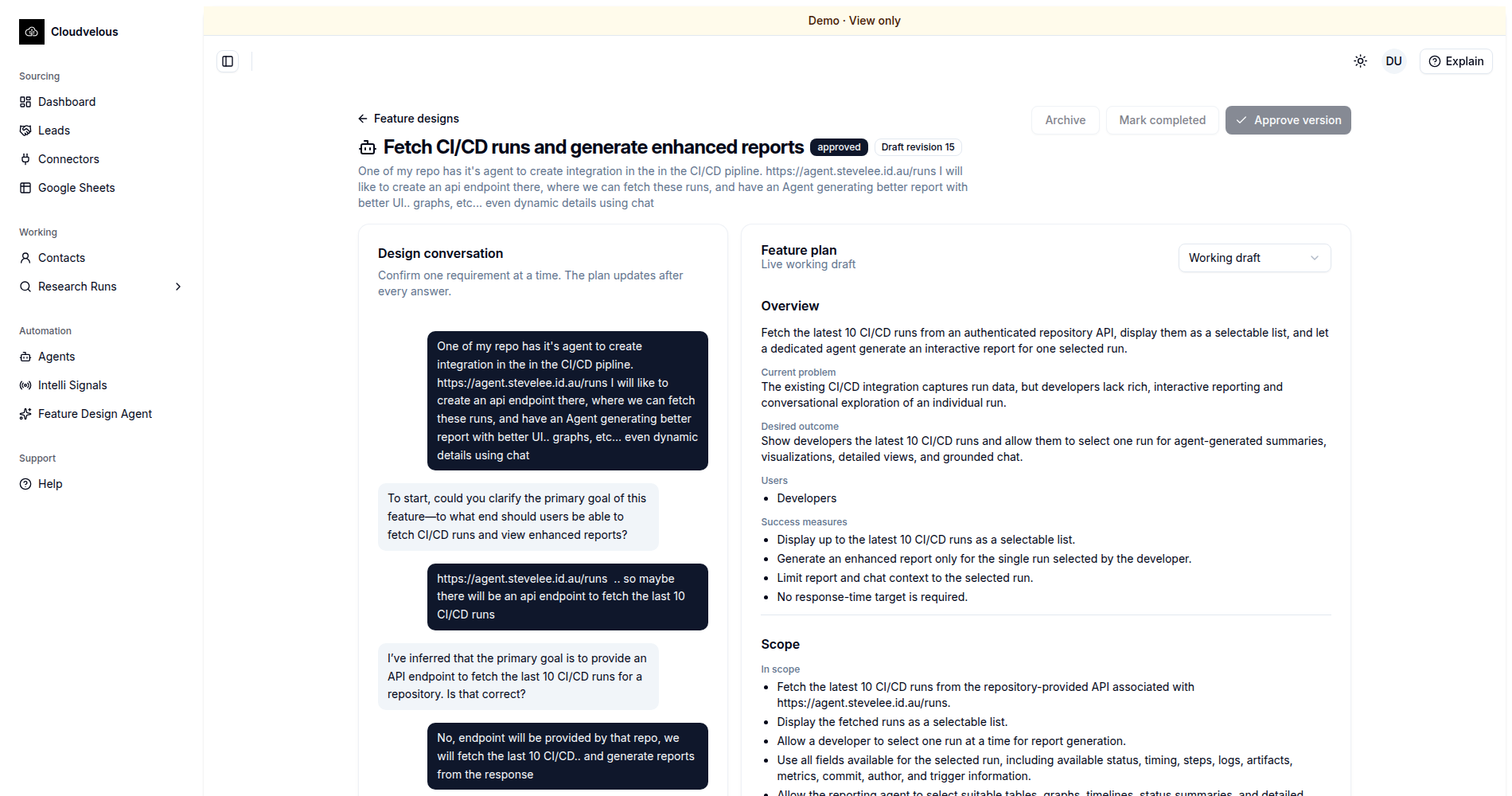
The plan covers delivery, not just the idea
By the end, that conversation had produced a full plan: an overview and success measures, in-scope and out-of-scope lists, seven numbered requirements each with its own acceptance criteria, a seven-step workflow naming which component does what, a new connector and a bounded read-only tool to create, a new dedicated agent (deliberately not just reusing the existing Inbound Leads Agent), backend/frontend/data work items, and a delivery section with dependencies, risks and mitigations, an implementation sequence, and concrete test scenarios.
Nothing gets built until a person approves it
Every connector, tool, and agent the plan proposes is marked to
create, but none of them exist yet while the design is still in
progress: the transcript for this one ends with an explicit note that
nothing has been created, only approval creates it. That approval gate is
also why the plan bothers to record which existing agent it deliberately
didn't reuse, and why a tool is scoped read-only and capped (10 runs, GET
only, no pipeline mutation) before it's ever wired to anything.